Ultrananocrystalline Diamond (UNCD)/Amorphous Carbon (a-C) Composite films
for Hard Coating and Photovoltaics
In recent years, studies on ultrananocrystalline diamond (UNCD) thin films
comprising diamond crystallites with diameters less than 10 nm have attracted
considerable attention from the physical and technological viewpoints because
of the following features:
a) some properties resemble those of diamond and diamond-like carbon
(DLC);
b) smooth surface, which is contrastive to that of polycrystalline
diamond;
c) higher temperature stability as compared to that of DLC;
d) unique optical and electric properties owing to a larger number
of grain boundaries in the film.
Moreover, it has been theoretically predicted that a large number of grain
boundaries, which are specific to UNCD films, strongly influence the electric
and optical properties of the UNCD film. For example, the n-type conduction
of nitrogen-doped UNCD films appears to be caused by the grain boundary
conductions. The UNCD thin film has remarkable properties that arise from
the grain boundaries.
● Our recent reports ●
"Chemical Bonding Structural Analysis of Nitrogen-Doped Ultrananocrystalline
Diamond/Hydrogenated Amorphous Carbon Composite Films Prepared by Coaxial
Arc Plasma Deposition"
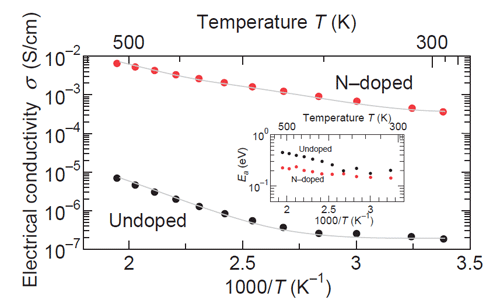
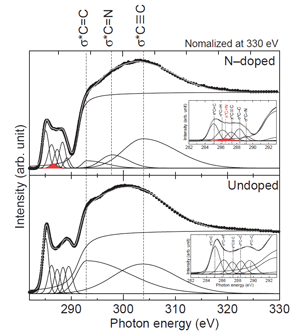
Nitrogen-doped ultrananocrystalline diamond/hydrogenated amorphous carbon composite films prepared in hydrogen and nitrogen mixed-gas atmospheres by coaxial arc plasma deposition with graphite targets were studied electrically and chemical-bonding-structurally. The electrical conductivity was increased by nitrogen-doping, accompanied by the production of n-type conduction. From X-ray photoemission, the near-edge X-ray absorption fine-structure, hydrogen forward-scattering, and Fourier transform infrared spectral results, it is expected that hydrogen atoms that terminate diamond grain boundaries are partially replaced by nitrogen atoms and resultantly CN and C=N bonds that easily generate free electrons are formed at grain boundaries.
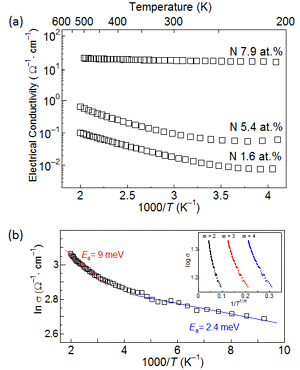
Temperature dependence of electrical conductivity of undoped and nitrogen-doped
UNCD/a-C:H films. Inset shows activation energy (Ea) versus 1/T plot.
(a) C K-edge NEXAFS spectra of undoped and nitrogen-doped UNCD/a-C:H films. (b) Magnifications of the NEXAFS spectra in the range of 282-294 eV.
"Room-temperature hard coating of ultrananocrystalline diamond/nonhydrogenated
amorphous carbon composite films on tungsten carbide by coaxial arc plasma
deposition"
Hiroshi Naragino, Mohamed Egiza, Aki Tominaga, Koki Murasawa, Hidenobu
Gonda, Masatoshi Sakurai, and Tsuyoshi Yoshitake
Ultrananocrystalline diamond (UNCD)/nonhydrogenated amorphous carbon (a-C)
composite films were deposited on unheated WC containing Co by coaxial
arc plasma deposition. The hardness of the film is 51.3 GPa, which is comparable
with the highest values of hard a-C films deposited on nonbiased substrates.
The deposited film is approximately 3 m thick, which is one order larger
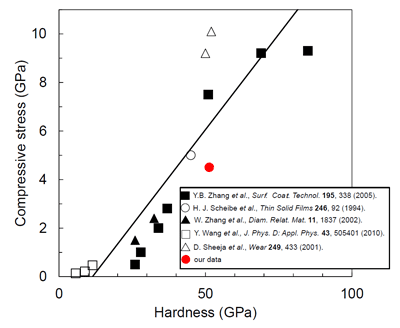
than that of hard a-C films. The internal compressive stress is 4.5 GPa,
which is evidently smaller than that of comparably hard a-C films. The
existence of a large number of grain boundaries in the UNCD/a-C film might
play a role in the release of the internal stress.
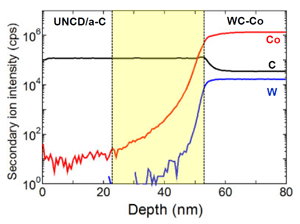
SIMS signals of C, W, and Co in depth direction range from WC-Co substrate
to initial part of UNCD/a-C film.
Compressive internal stress of UNCD/a-C and hard a-C films.
"Hydrogenation effects on carrier transport in boron-doped ultrananocrystalline
diamond/amorphous carbon films prepared by coaxial arc plasma deposition"
Yūki Katamune, Satoshi Takeichi, Shinya Ohmagari, and Tsuyoshi Yoshitake
J. Vac. Sci. Tech. A, Vol. 6, Issue 6 (2015) 061514.
Boron-doped ultrananocrystalline diamond/hydrogenated amorphous carbon
composite (UNCD/a-C:H) films were deposited by coaxial arc plasma deposition
with a boron-blended graphite target at a base pressure <10-3 Pa and at hydrogen pressures ≤53.3 Pa. The hydrogenation effects on the
electrical properties of the films were investigated in terms of chemical
bonding. Hydrogen-scattering spectrometry showed that the maximum hydrogen
content was 35 at% for the film produced at 53.3-Pa hydrogen pressure.
The Fourier-transform infrared spectra showed strong absorptions by sp3
CH bonds, which were specific to the UNCD/a-C:H, and can be attributed
to hydrogen atoms terminating the dangling bonds at UNCD grain boundaries.
Temperature-dependence of the electrical conductivity showed that the films
changed from semi-metallic to semiconducting with increasing hydrogen pressure,
i.e., with enhanced hydrogenation, probably due to hydrogenation suppressing
the formation of graphitic bonds, which are a source of carriers. Carrier
transport in semiconducting hydrogenated films can be explained by a variable-range
hopping model. The rectifying action of heterojunctions comprising the
hydrogenated films and n-type Si substrates implies carrier transport in
tunneling.
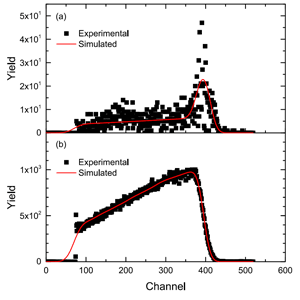
Hydrogen forward-scattering spectra of undoped films deposited (a) at base
pressure of <10-3 Pa and (b) at H2 pressure of 53.3 Pa. Squares and
solid red curve show the experimental and simulated data, respectively.
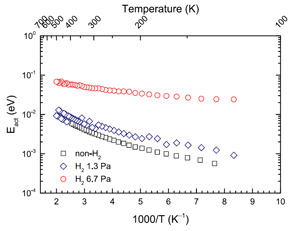
Actual activation energies of B-doped films deposited at base pressure
of <10-3 Pa, and at H2 pressures of 1.3 and 6.7 Pa.
"Electrical Characteristics of Nitrogen-Doped Ultrananocrystalline
Diamond/Hydrogenated Amorphous Carbon Composite Films Prepared by Coaxial
Arc Plasma Deposition"
Abdelrahman Zkria, Hiroki Gima, Mahmoud Shaban, and Tsuyoshi Yoshitake
Appl. Phys. Express, Vol. 8, No. 9 (2015) 095101.
Nitrogen-incorporated ultrananocrystalline diamond/hydrogenated amorphous carbon composite (UNCD/a-C:H) films were synthesized in nitrogen and hydrogen mixed gas atmospheres by coaxial arc plasma deposition. The temperature dependence of the electrical resistivity implies that carriers are transported in hopping conduction. Heterojunction comprising 3 at.% nitrogen-doped films and p-Si substrates exhibited a typical rectifying action. The expansion of a depletion region into the film side was confirmed by the capacitance–voltage characteristics, and the built-in potential and carrier concentration were estimated to be 0.51 eV and 7.5×1016 cm-3, respectively. It was experimentally demonstrated that nitrogen-doped
UNCD/a-C:H is applicable as an n-type semiconductor..
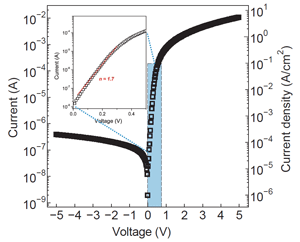
Current–voltage characteristics of heterojunction diode comprised of nitrogen-doped
UNCD/a-C:H and p-type Si. Inset shows magnification of the I-V curve in
the low forward current range.
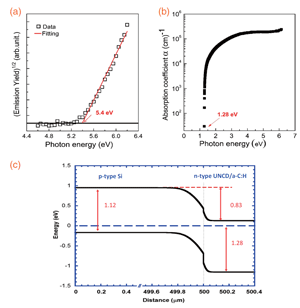
(a) Photoelectron emission spectra of nitrogen-doped UNCD/a-C:H film, (b)
optical absorption spectrum, and (c) energy band diagram of heterojunction
comprising nitrogen-doped UNCD/a-C:H and p-type Si.
"A synthesis method of ultrananocrystalline diamond in powder employing
a coaxial arc plasma gun"
Hiroshi Naragino, Aki Tominaga, Kenji Hanada, and Tsuyoshi Yoshitake
Appl. Phys. Express, Vol. 8, No. 7 (2015) 075101.
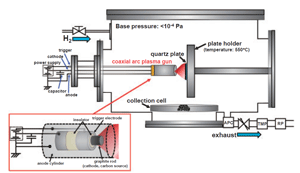
A new method that enable us to synthesize ultrananocrystalline diamond
(UNCD) in powder compactly, briefly, and flexibly is proposed. Highly energetic
carbon species such as C+ ions ejected from a graphite cathode of a coaxial
arc plasma gun are provided on a quarts plate in a high density by repeated
arc discharge in a compact vacuum chamber, and resultant films automatically
peeled from the plate are aggregated and powdered. The existence of a huge
number of diamond grains with diameters of less than 10 nm was confirmed
by transmission electron microscopy and powder X-ray diffraction. It was
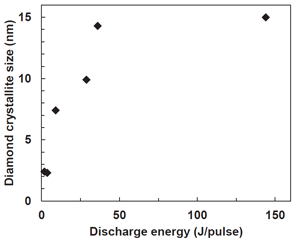
found that the grain size is easily controllable from 2.4 to 15.0 nm with
increasing arc discharge energy from 1.8 to 144 J/pulse. The optical emission
spectroscopic observation of arc plasma implied that highly energetic atomic
carbon species such as carbon ions contribute to the formation of UNCD
grains. It was experimentally demonstrated that this is a new promising
method that makes possible the synthesis of UNCD in powder easily and controllably.
In addition, from the synthesis principle, this is a potential method that
can not only synthesize a high purity UNCD but also easily dope foreign
elements for functionalizing UNCD.
Schematic diagram of powder UNCD preparation apparatus..
Diamond crystallite sizes against discharge energy, estimated using full
width at half-maximum (FWHM) of diamond-111 peaks on XRD patterns by Scherrer’s
equation.
"Carrier Transport and Photodetection in Heterojunction Photodiodes
Comprising n-Type Silicon and p-Type Ultrananocrystalline Diamond/Hydrogenated
Amorphous Carbon Composite Films"
Carrier transport and photodetection in heterojunction photodiodes comprising
n-type Si substrates and p-type B-doped ultrananocrystalline diamond/hydrogenated
amorphous carbon composite (UNCD/a-C:H) films were investigated. Their
transport model was discussed mainly on the basis of electrical measurements.
It was revealed that an a-C:H matrix in UNCD/a-C:H would predominantly
be responsible for carrier transportation in the photodiodes. The photodiodes
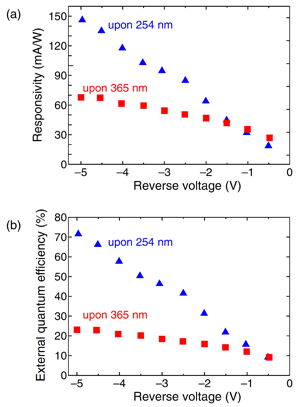
exhibited high external quantum efficiencies of 72 and 23% under 254 and
365nm UV illuminations, respectively. These superior responses might be
attributable to the photocarrier generation in UNCD grains accompanied
by an efficient carrier transport to the a-C:H matrix.
(a) Prospective energy band diagram of heterojunction photodiodes. (b)
Schematic image of heterojunction interface. The arrows shown in red and
blue denote the electron injection path from n-type Si under forward bias
conditions.
(a) Responsivity and (b) external quantum efficiency of photodiodes comprising
3 at.% B-doped UNCD/a-C:H and n-type Si at wavelengths of 254 and 365 nm.
"Heterojunction Diodes Comprising p-Type Ultrananocrystalline Diamond
Films Prepared by Coaxial Arc Plasma Deposition and n-Type Silicon Substrates"
Heterojunction diodes, which comprise boron-doped p-type ultrananocrystalline
diamond/hydrogenated amorphous carbon composite (UNCD/a-C:H) films prepared
by coaxial arc plasma deposition and n-type Si substrates, were electrically
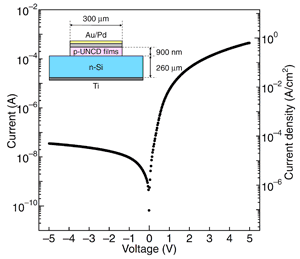
studied. The current–voltage characteristics showed a typical rectification
action. An ideality factor of 3.7 in the forward-current implies that carrier
transport is accompanied by some processes such as tunneling in addition
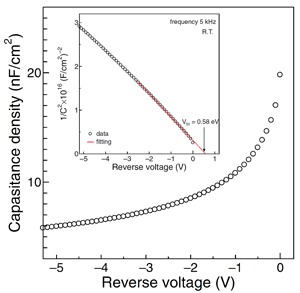
to the generation–recombination process. From the capacitance–voltage measurements,
the built-in potential was estimated to be approximately 0.6 eV, which
is in agreement with that in a band diagram prepared on the assumption
that carriers are transported in an a-C:H matrix in UNCD/a-C:H. Photodetection
for 254nm monochromatic light, which is predominantly attributable to photocurrents
generated in UNCD grains, was evidently confirmed in heterojunctions. Since
dangling bonds are detectable by electron spin resonance spectroscopy,
their control might be an important key for improving the rectifying action
and photodetection performance.
I–V characteristics of heterojunction diode comprising boron-doped UNCD/a-C:H
film and n-type Si substrate. The inset shows the schematic of the diode.
C–V characteristics in reverse-voltage range of heterojunction diode comprising
boron-doped UNCD/a-C:H films and n-type Si substrate. The inset shows the
plot of 1/C2–V.
Deep-ultraviolet (DUV) light detection of p-type ultrananocrystalline diamond/hydrogenated
amorphous carbon composite (UNCD/a-C:H) films prepared by pulsed laser
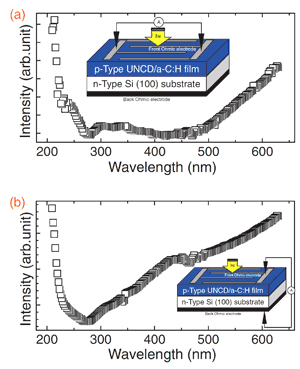
deposition was investigated. The photocurrent spectra revealed that the
UNCD/a-C:H films possess strong responses in the wavelength range between
210 and 280 nm, which might originate from UNCD grains. The heterojunction
photodiodes comprised of p-type UNCD/a-C:H and n-type Si exhibited an obvious
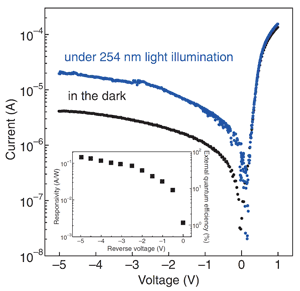
photovoltaic action for 254nm DUV light illumination. The external quantum
efficiency and responsivity of the photodiodes were estimated to be 71%
and 130mA/W, respectively. It was proved that UNCD/a-C:H is a new promising
material applicable to DUV photodetectors.
Spectral response of heterojunction diodes comprised of n-type Si substrates
and p-type UNCD/a-C:H films in the wavelength range between 630 and 210
nm. The measurements were conducted in lateral and vertical diode configurations
as shown in the insets (a) and (b), respectively.
Current–voltage characteristic of heterojunction photodiodes evaluated
in the dark and under illumination with a 254nm monochromatic lamp. The
inset shows the reverse bias dependence of the responsivity and external
quantum efficiency.
"Enhanced growth of diamond grains in ultrananocrystalline diamond/hydrogenated
amorphous carbon composite films by pulsed laser deposition with boron-blended
graphite targets"
Shinya Ohmagari, Yūki Katamune, Hikaru Ichinose, and Tsuyoshi Yoshitake
Jpn. J. Appl. Phys. Vol. 51, No. 2 (2012) 025503.
Ultrananocrystalline diamond (UNCD)/hydrogenated amorphous carbon composite
films were prepared by pulsed laser deposition with boron-blended graphite
targets and the effects of the boron-doping on the growth of UNCD grains
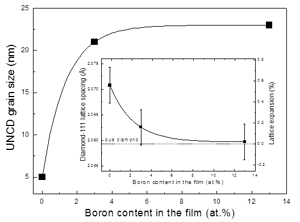
were investigated. With an increase in the boron content, the grain size
was increased from 5 to 23 nm accompanied by the lattice constant approaching
that of bulk diamond. The sp3/(sp3 + sp2) ratio estimated from the X-ray photoemission spectra was enhanced by
the boron-doping, which might be predominantly attributable to the enlarged
grains. The near-edge X-ray absorption fine-structure spectroscopic measurement
revealed that boron atoms are preferentially distributed into grain boundaries.
On the basis of the results, the roles of the boron atoms in the enhanced
crystalline growth are discussed. We consider that the crystalline growth
posterior to the nucleation is facilitated by boron atoms neighboring UNCD
grains or by boron-containing energetic species in plasma.
UNCD grain sizes estimated from diamond-111 diffraction peaks as a function
of the boron content. The inset shows the diamond-111 lattice spacing and
lattice expansion versus the boron content.
Near-edge X-ray absorption fine structure C K-edge spectra of (a) undoped,
(b) 3 at.% and (c) 13 at.% boron doped UNCD/a-C:H films.
"Near-Edge X-ray Absorption Fine-Structure Spectroscopic Study on
Nitrogen-Doped Ultrananocrystalline Diamond/Hydrogenated Amorphous Carbon
Composite Films Prepared by Pulsed Laser Deposition"
Sausan Al-Riyami, Shinya Ohmagari, and Tsuyoshi Yoshitake
Jpn. J. Appl. Phys. Vol. 50, No. 8 (2011) 08JD05.
Nitrogen-doped ultrananocrystalline diamond (UNCD)/hydrogenated amorphous
carbon (a-C:H) composite films, which possessed n-type conduction with
enhanced electrical conductivities, were deposited by pulsed laser deposition.
The film doped with a nitrogen content of 7.9 at.% possessed an enhanced
electrical conductivity of 18 Ω‒1cm‒1 at 300 K. The near-edge x-ray absorption
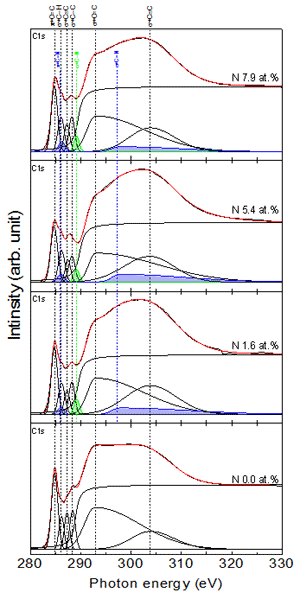
fine-structure (NEXAFS) measurement exhibited the appearance of additional
peaks due to π*C=N, σ*C=N, and σ*C−N bonds as compared to the spectra of
undoped films. The sp2 bonding fraction estimated from the NEXAFS spectra
was increased with the nitrogen content. The enhanced electrical conductivities
are probably attributed to the formation of additional π* and σ* states
and the enhancement in the sp2 bonding fraction.
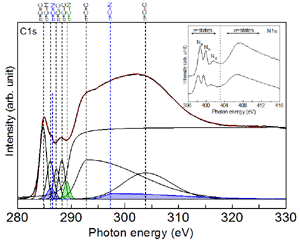
NEXAFS spectra, which are decomposed with an error function step and Gaussians,
of 7.9, 5.4, 1.6 at.% nitrogen-doped, and undoped UNCD/a-C: H films.
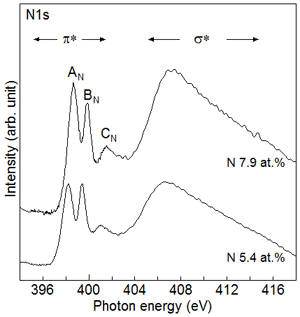
N K-edge NEXAFS spectra of 7.9 and 5.4 at.% nitrogen-doped UNCD/a-C:H films.
"p-Type Ultrananocrystalline Diamond:Hydrogenated Amorphous Carbon
Composite/n-Type Si Heterojunction Diodes Fabricated by Pulsed Laser Deposition"
Shinya Ohmagari, Sausan Al-Riyami, and Tsuyoshi Yoshitake
Jpn. J. Appl. Phys. Vol. 50, No. 3 (2011) 035101.
p-Type ultrananocrystalline diamond:hydrogenated amorphous carbon composite
(UNCD:a-C:H)/n-type Si heterojunction diodes, wherein 3 at.% boron-doped
UNCD:a-C:H layers were deposited on Si substrates by pulsed laser deposition,
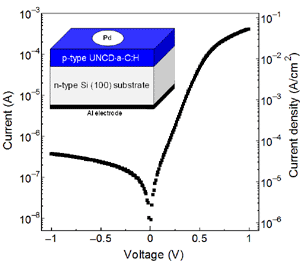
were electrically studied. The current-voltage (I-V) characteristics showed
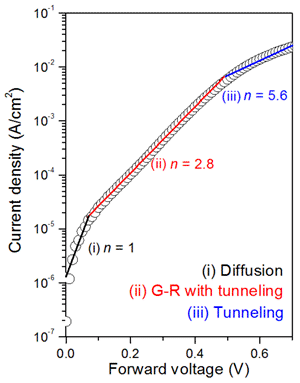
the typical rectification action with a leakage current density of 4.7×10⁻⁵ A/cm2 at a reverse voltage of –1 V. The carrier transport is expected to be
in generation-recombination process accompanied by tunneling at low forward
voltages of 0.1 – 0.5 V, and to be predominantly in tunneling at 0.5 –
1.0 eV, from ideality factors estimated from the forward I-V curve. Grain
boundaries in the UNCD:a-C:H layer might act as trap centers for tunneling.
From the capacitance-voltage measurement, the build-in potential of the
heterojunction and an active carrier concentration in the p-type UNCD:a-C:H
layer were estimated to be 0.6 eV and 1017cm–3, respectively.
Current-voltage characteristics of a p-type UNCD×a-C:H/n-type Si heterojunction
diode. The inset shows the schematic of the structure.
Current-voltage characteristics in the forward voltage range, which is
magnified from the current-voltage curve as shown in Fig. 1. The ideality
factor (n) is estimated to be 1, 2.8, and 5.6 for the regions (i), (ii),
and (iii), respectively.
"Formation of Ultrananocrystalline Diamond/Amorphous Carbon Composite
Films in Vacuum Using Coaxial Arc Plasma Gun"
Kenji Hanada, Tomohiro Yoshida, You Nakagawa, and Tsuyoshi Yoshitake
Jpn. J. Appl. Phys. Vol. 49, No. 12 (2010) 125503.
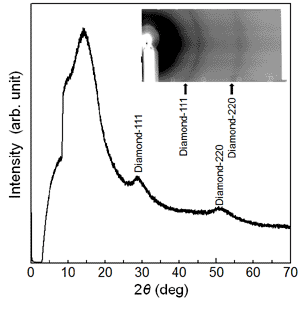
Ultrananocrystalline diamond (UNCD)/nonhydrogenated amorphous carbon (a-C)
composite films were grown in vacuum using a coaxial arc plasma gun. From
the X-ray diffraction measurement, the UNCD crystallite size was estimated
to be 1.6 nm. This size is dramatically reduced from that (2.3 nm) of UNCD/hydrogenated
amorphous carbon (a-C:H) composite films grown in a hydrogen atmosphere.
The sp3/(sp3 + sp2) value, which was estimated from the X-ray photoemission
spectrum, was also reduced to be 41%. A reason for it might be the reduction
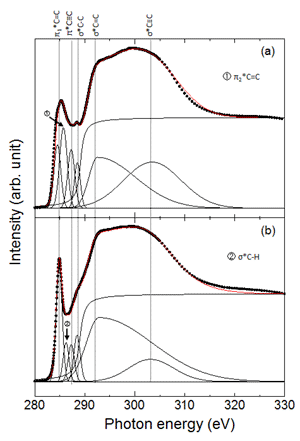
in the UNCD crystallite size. From the near-edge X-ray absorption fine-structure
(NEXAFS) spectrum, it was found that the π*C=C and π*C≡C bonds are preferentially
formed instead of the σ*C-H bonds in the UNCD/a-C:H films. Since the extremely
small UNCD crystallites (1.6 nm) correspond to the nuclei of diamond, we
consider that UNCD crystallite formation should be due predominantly to
nucleation. The supersaturated condition required for nucleation is expected
to be realized in the deposition using the coaxial arc plasma gun.
XRD pattern of UNCD/a-C film. It was transformed from Debye-Scherer rings
recorded on an imaging plate, as shown in the inset.
NEXAFS spectra of (a) UNCD/a-C and (b) UNCD/a-C:H films.
"Nitrogen-Doped Ultrananocrystalline Diamond/Hydrogenated Amorphous
Carbon Composite Films Prepared by Pulsed Laser Deposition"
Sausan Al-Riyami, Shinya Ohmagari, and Tsuyoshi Yoshitake
Nitrogen-doped ultrananocrystalline diamond (UNCD)/hydrogenated amorphous carbon composite films were deposited
by pulsed laser deposition. The film doped with a nitrogen content of 7.9
at.% possessed n-type conduction with an electrical conductivity of 18
Ω-1cm-1 at 300 K. A heterojunction with p-type Si exhibited typical rectifying
action. The UNCD grain size was estimated to be 2.5 nm from X-ray diffraction
measurement. Near-edge X-ray absorption fine structure and Fourier transform
infrared spectroscopies revealed the preferential formations of C=N and
C-N bonds and an enhanced amount of sp2 bonds in the films.
(a) Temperature dependence of the electrical conductivities (σ) of 7.9,
5.4, and 1.6 at. % nitrogen-doped UNCD/a-C:H films and (b) Arrhenius plot
of the electrical conductivity of 7.9 at. % nitrogen-doped UNCD/a-C:H films.
The inset shows the electrical conductivity plotted in T1/m, where T is the temperature and m = 2, 3, and 4.
C K-edge NEXAFS spectrum of 7.9 at.% nitrogen-doped UNCD/a-C:H film. The
inset shows N K-edge NEXAFS spectra of 7.9 and 5.4 at.% nitrogen-doped
UNCD/a-C:H films.
"Time-Resolved Spectroscopic Observation of Deposition Processes of
Ultrananocrystalline Diamond/Amorphous Carbon Composite Films by Using
a Coaxial Arc Plasma Gun"
Kenji Hanada, Tsuyoshi Yoshitake, Takashi Nishiyama, and Kunihito Nagayama
Jpn. J. Appl. Phys. Vol. 49, No. 8 (2010) 08JF09.
Deposition using a coaxial arc plasma gun (CAPD) of ultrananocrystalline
diamond (UNCD)/amorphous carbon composite films in vacuum and for comparison
in a 53.3-Pa hydrogen atmosphere was spectroscopically observed using a
high-speed camera equipped with narrow-bandpass filters. UNCD crystallites
with diameters of approximately 1.6 nm can be formed even in vacuum. The
extremely small crystallites imply that the formation is predominantly
due to nucleation without the consequence growth. Even in vacuum, emissions
from C+ ions, C atoms, and C2 dimers lasted for approximately 100 μs although
emission lifetimes of species are generally 10 ns. We believe that the
nucleation is attributed to the supersaturated situation comprised of the
excited carbon species with large number densities.
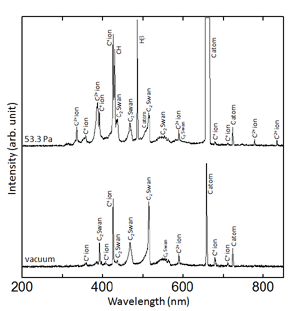
Optical emission spectra of plasmas in a 53.3-Pa hydrogen atmosphere and
vacuum.
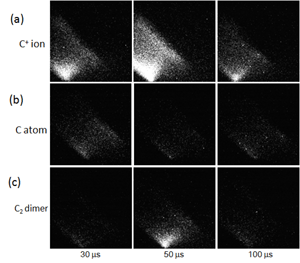
Time-resolved photographs of plasmas in vacuum, taken using (a) 394-nm
(C+ ion), (b) 505-nm, and (c) 515-nm (C2 dimer) bandpass filters.
"X-ray Photoemission Spectroscopy of Nitrogen-Doped UNCD /a-C:H Films
Prepared by Pulse Laser Deposition"
Sausan Al-Riyami, Shinya Ohmagari, and Tsuyoshi Yoshitake
Diamond Relat. Mater. Vol. 19 (2010) pp. 510-513.
Nitrogen-doped ultrananocrystalline diamond (UNCD)/hydrogenated amorphous
carbon (a-C:H) films were deposited by pulse laser deposition (PLD). Nitrogen
contents in the films were controlled by varying a ratio in the inflow
amount between nitrogen and hydrogen gases. The film doped with a nitrogen
content of 7.9 at. % possessed n-type conduction with an electrical conductivity
of 18 Ω-1cm-1 at 300 K. X-ray potoemission spectra, which were measured using synchrotron
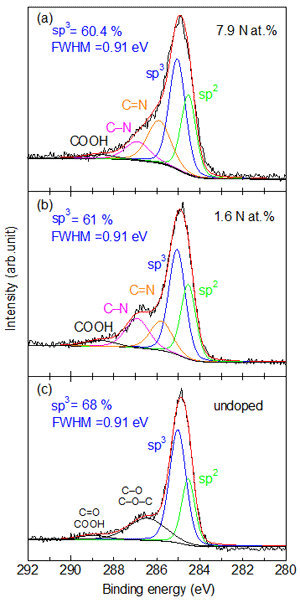
radiation, were decomposed into four component spectra due to sp2, sp3 hybridized carbons, C=N and C-N. A full-width at half-maximum of the sp3 peak was 0.91 eV. This small value is specific to UNCD/a-C:H films. The
sp2/(sp3 + sp2) value was enhanced from 32 to 40% with an increase in the nitrogen content
from 0 to 7.9 at. %. This increment probably originates from the nitrogen
incorporation into an a-C:H matrix and grain boundaries of UNCD crystallites.
Since an electrical conductivity of a-C:H does not dramatically enhanced
for this doping amount according to previous reports, we believe that the
electrical conductivity enhancement is predominantly due to the nitrogen
incorporation into grain boundaries.
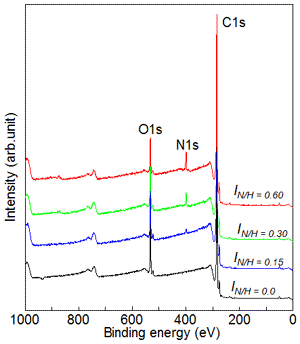
X-ray photoemission spectra of UNCD/a-C:H films prepared at different inflow
ratios IN/H.
Typical X-ray photoemission C1s spectra of (a) 7.9-at.% nitrogen-doped,
(b) 1.6-at.% nitrogen-doped, and (c) undoped UNCD/a-C:H films.
"Formation of p-Type Semiconducting Ultrananocrystalline Diamond/Hydrogenated
Amorphous Carbon Composite Films by Boron Doping"
p-Type ultrananocrystalline diamond (UNCD)/hydrogenated amorphous carbon
(a-C:H) composite films were fabricated by pulsed laser deposition using
boron-doped graphite targets. Thermal analysis confirmed the occurrence
of p-type conduction. The electrical conductivity increased with the doped
amount of boron. An activation energy estimated from the Arrhenius plot
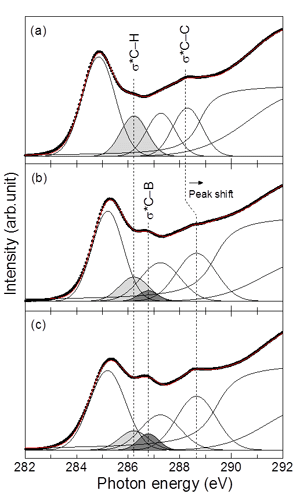
was approximately 0.1 eV. Near-edge X-ray absorption fine structure spectra
revealed that the σ*C−H peak weakened and the σ*C−B peak strengthened with an increase in the doped amount of boron. Fourier
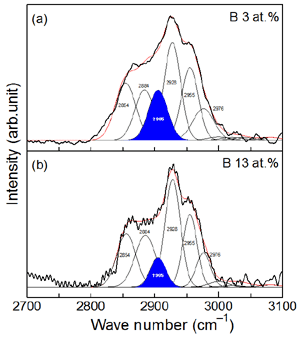
transform infrared spectroscopy showed that the sp3 C−H peak weakened with
the doped amount of boron. These probably indicate that the hydrogen atoms
that terminate the dangling bonds of UNCD crystallites are partially replaced
with boron atoms.
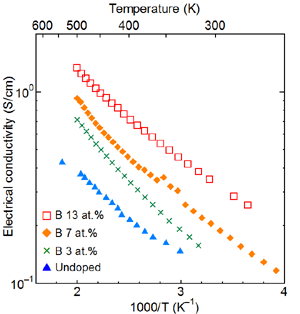
Temperature dependence of electrical conductivity of boron-doped UNCD/a-C:H
films for different boron contents.
NEXAFS B 1s spectra of (a) 3 at.% boron-doped UNCD/a-C:H and (b) 13 at.%
boron-doped UNCD/a-C:H films.
"Structural and Physical Characteristics of Ultrananocrystalline Diamond/Hydrogenated
Amorphous Carbon Composite Films Deposited Using a Coaxial Arc Plasma Gun"
Tsuyoshi Yoshitake, You Nakagawa, Akira Nagano, Ryota Ohtani, Hiroyuki
Setoyama, Eiichi Kobayashi, Kazushi Sumitani, Yoshiaki Agawa, and Kunihito
Nagayama
Jpn. J. Appl. Phys. Vol. 49, No. 1 (2010) 015503.
Ultrananocrystalline diamond (UNCD)/hydrogenated amorphous carbon films
were formed without initial nucleation using a coaxial arc plasma gun.
The UNCD crystallite diameters estimated from the X-ray diffraction peaks
were approximately 2 nm. The Fourier transform infrared absorption spectrum
exhibited an intense sp3-CH peak that might originate from the grain boundaries
between UNCD crystallites whose dangling bonds are terminated with hydrogen
atoms. A narrow sp3 peak in the photoemission spectrum implied that the
film comprises a large number of UNCD crystallites. Large optical absorption
coefficients at photon energies larger than 3 eV that might be due to the
grain boundaries are specific to the UNCD/a-C:H films.
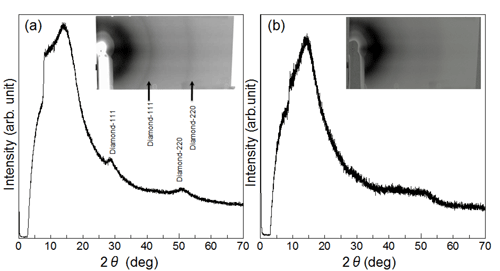
X-ray diffraction patterns of (a) UNCD/a-C:H films and (b) background (empty
capillary) measured with 12 keV synchrotron radiation. Insets show Debye-Scherrer
rings obtained with imaging plates.
NEXAFS spectrum of UNCD/a-C:H film.
"Near-edge X-ray absorption fine-structure, X-ray photoemission, Fourier
transfer infrared spectroscopies of ultrananocrystalline diamond/hydrogenated
amorphous carbon composite films"
The chemical bonding structure of ultrananocrystalline diamond (UNCD)/hydrogenated
amorphous carbon (a-C:H) composite films prepared by pulsed laser deposition
was examined by near-edge X-ray absorption fine-structure (NEXAFS), X-ray
photoemission, and Fourier transform infrared (FTIR) spectroscopies. An
intense sp3-CH peak was observed in the FTIR spectrum. This implies that
the sp3-CH peak originates from the grain boundaries between UNCD crystallites,
wherein dangling bonds are terminated with hydrogen atoms. The presence
of an intense σ*C−C peak in the NEXAFS spectrum and a narrow sp3 peak in
the photoemission spectrum was specific to UNCD/a-C:H films; these confirm
the existence of UNCD crystallites.
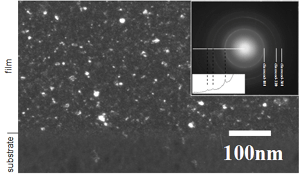
Dark-field TEM image formed with part of a diamond-111 diffraction ring
and selected-area electron diffraction pattern of UNCD/a-C:H films.
ITypical X-ray photoemission spectrum of UNCD/a-C:H films.
"Spectral absorption properties of ultrananocrystalline diamond/amorphous
carbon composite thin films prepared by pulsed laser deposition"
Tsuyoshi YOSHITAKE, Akira NAGANO, Masaru ITAKURA, Noriyuki KUWANO, Takeshi
HARA, and Kunihito NAGAYAMA
Jpn. J. Appl. Phys. Part 2, Vol. 46, No.38, 2007, pp.L936 - L938.
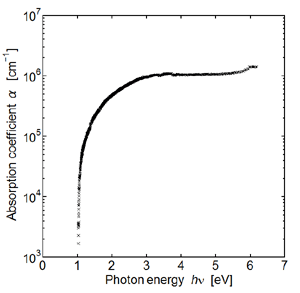
The spectral absorption properties of ultrananocrystalline diamond (UNCD)/amorphous
carbon composite films grown by pulsed laser deposition with graphite were
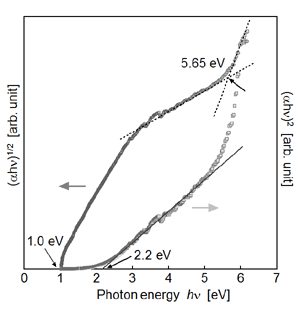
experimentally investigated. The indirect optical band gaps estimated from
the absorption spectrum were 1.0 eV and approximately 5.65 eV, which correspond
to those for the amorphous carbon surrounding the UNCDs and for UNCDs themselves,
respectively. In addition, the spectrum revealed a direct gap having a
value of approximately 2.2 eV. One probable origin can be the presence
of grain boundaries between UNCDs and amorphous carbon since they are specific
to UNCD/amorphous carbon; further, its appearance is consistent with the
theoretical predictions.
Optical absorption spectrum of the UNCD/a-C film.
Optical absorption spectra plotted in the ordinate axes of (ahu)1/2 and
(ahu)2.