Heteroepitaxial Growth of Cubic AlN Thin Films on Sapphire and The Application to Underlayers for Single Crystalline Diamond Growth
Hexagonal AlN (α-AlN) is a wide-gap III-V compound semiconductor possessing
high thermal conductivity, chemical and thermal stability, and acoustical
properties. Thus, it is a promising material for applications in optoelectronic
and high-temperature microelectronics devices. On the other hand, few studies
have reported on metastable cubic AlN (β-AlN). The physical properties
of the cubic AlN might be different from those of α-AlN. β-AlN is expected
to possess higher ballistic electron velocities, thermal conductivity,
and acoustic velocity than α-AlN due to its higher crystallographic symmetry.
This is interesting from the physical as well as practical viewpoints.
β-AlN has two types of structures—the NaCl type
with a lattice constant of 4.045 Å, and the zincblende type with lattice
constants of 7.9131, and 4.38 Å. Two different lattice constants have been
reported for the zincblende type. The epitaxial growths of zincblende-type
β-AlN on Si(111), Si(001), and MgO(001) have been reported. For sapphire
(0001), the epitaxial growth of β-AlN with the following relationship is
expected: β-AlN(111) //sapphire(0001)[010] with lattice mismatches of 20%
for the NaCl type and 17 and 30% for the zincblende types with the lattice
constants of 7.913 and 4.38 Å respectively.
We have been interested in heteroepitaxial growth of diamond on widely-usable single crystalline substrates such as MgO and sapphire. β-AlN possesses a similar crystalline structure, and it is a new candidate for an underlayer for heteroepitaxial growth of diamond thin films in my opinion. At first we will make an effort to grow β-AlN thin films heteroepitaxially on sapphire, and after that we are going to challenge to grow diamond thin films heteroepitaxially on the single crystalline β-AlN thin films.
● Our recent reports ●
"Synchrotron X-ray Diffraction Study of Single-Phase β-AlN Thin Film Heteroepitaxially Grown on a Sapphire(0001) Substrate by Pulsed Laser Deposition"
Kazushi Sumitani , Ryota Ohtani, Tomohiro Yoshida, You Nakagawa, Satoshi Mohri, and Tsuyoshi Yoshitake
Jpn. J. Appl. Phys. Vol. 49, No. 2 (2010) 020212.
β-AlN films grown on sapphire (0001) substrates by pulsed laser deposition
were crystallographically evaluated by X-ray diffraction using synchrotron
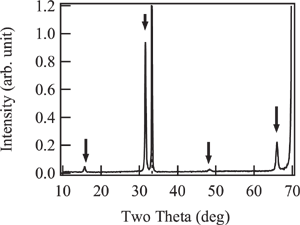
radiation at the SAGA Light Source. A θ–2θ measurement suggested that single-phase
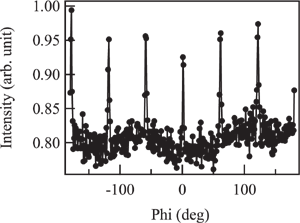
β-AlN was grown. From measurements of β-AlN 1-11 diffraction spots, it
was found that β-AlN with a lattice constant of 7.90 ± 0.06 Å was heteroepitaxially grown on the substrate with a relationship of β-AlN(111)[1-21]
ǁ Al2O3(0001)[11-20]. The film was composed of highly-oriented β-AlN crystallites
with an average diameter of
about 100 Å.
 |
 |
|
|
Diffraction profile of the θ-2θ measurement. The peaks attributable to the film are indicated by the arrows. The sharp peaks at 2θ = 33.3 and 69.9 are 0006 and 00012 Bragg peaks from the sapphire substrate. |
X-ray intensities related to AlN 1-11 diffraction spots as a |
"Growth of metastable β-AlN by pulsed laser deposition"
Tsuyoshi YOSHITAKE , Satoshi MOHRI, Takeshi HARA, and Kunihito NAGAYAMA
Jpn. J. Appl. Phys. Vol. 47, No. 5 (2008) pp. 3600-3602.
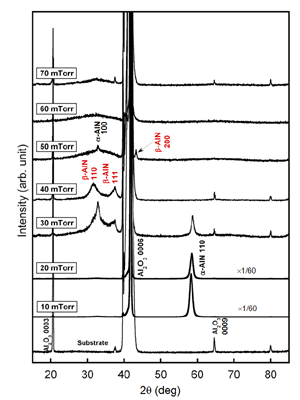
Aluminum nitride (AlN) thin films were prepared on sapphire (0001) in ambient nitrogen by pulsed laser deposition using a sintered AlN target, and the film structure was evaluated by X-ray diffraction and scanning electron microscopy. The central area of the film was partially studded with cubic AlN (β-AlN) crystallites with obvious facets. This area was located on the normal of the irradiation spot on the target, and it corresponded to the region on the film where the highly energetic and dense species were deposited. A nonequilibrium condition and large supply of nitrogen are both important factors for the growth of metastable β-AlN.
 |
 |
|
|
XRD patterns of the films deposited at different nitrogen pressures. |
SEM images of the film deposited at a nitrogen pressure of 40-50 mTorr. |